
The comparison between sales enablement versus buyer enablement usually appears when revenue teams sense that effort and outcomes are no longer aligned. Sellers are active, pipelines look full, and conversations are happening, yet deals stall or stretch far longer than expected. In these situations, the issue is rarely motivation or messaging. It is usually a mismatch between how sellers are enabled and how buyers are supported through decision making.
Sales enablement and buyer enablement are closely related, but they exist to solve different problems. Treating them as the same concept often leads teams to over optimize internal execution while leaving buyers to navigate complex decisions on their own. Understanding the difference is essential for diagnosing friction and building systems that support sustainable growth.
Sales enablement refers to the systems, processes, and shared knowledge that help sales teams operate consistently and effectively. Its primary purpose is to ensure sellers know how to engage buyers, communicate value, and progress opportunities in a repeatable way.
Sales enablement is internal by design. It focuses on readiness. This includes onboarding new sellers, standardizing messaging, clarifying qualification criteria, and reinforcing how deals should be run from first conversation through close. When sales enablement is strong, sellers across the organization approach similar situations with similar structure, even if their styles differ.
Chronologically, sales enablement supports sellers from the earliest stages of the revenue process. It influences how discovery is conducted, how needs are framed, and how opportunities are assessed. Over time, it reduces dependency on individual intuition and replaces it with shared patterns based on what has worked before.
Buyer enablement focuses on a different part of the equation. It exists to support buyers as they move through the work required to make a decision.
Once a sales conversation begins, buyers face challenges that are often invisible to sellers. They must align internally on the problem, agree on evaluation criteria, compare alternatives, manage risk, and reach consensus among stakeholders with different priorities. These steps are not automatic, and they do not follow a clean sequence.
Buyer enablement provides structure to this process. It helps buyers organize information, understand what decisions remain, and bring others into the conversation without losing context. Instead of pushing buyers forward, buyer enablement removes obstacles that slow them down.
Buyer enablement becomes increasingly important as deals move into evaluation and approval phases. When interest is high but progress slows, buyer enablement is often the missing layer.
The simplest way to understand sales enablement versus buyer enablement is to look at who each discipline is designed to help first.
Sales enablement is designed to help sellers execute effectively. Buyer enablement is designed to help buyers decide confidently.
Sales enablement answers the question of whether the seller knows what to do next and how to do it well. Buyer enablement answers whether the buyer knows how to move forward internally and complete the decision process.
This distinction matters because the same asset can serve very different purposes depending on intent. A presentation can help a seller explain value, or it can help a buying group align around priorities. When teams do not clarify intent, enablement efforts become unfocused.
In practice, sales enablement shows up as clarity and consistency. Sellers know which conversations matter at which stage. They understand how to frame problems in a way that resonates with buyers. They have access to information that supports the conversation they are having right now, not a generic library of materials.
Sales enablement also creates feedback loops. Patterns from successful and unsuccessful deals inform training, messaging, and process improvements. Over time, this creates a learning system where execution improves continuously rather than through periodic overhauls.
When sales enablement is weak, teams rely on individual experience. Outcomes vary widely. Forecasts become unreliable. Deals fail for preventable reasons such as misaligned expectations or missed steps.
Buyer enablement works by reducing cognitive and organizational friction. It recognizes that buyers are often managing decisions alongside full time responsibilities and competing priorities.
In practice, buyer enablement helps buyers answer practical questions. Who needs to be involved. What information matters most. What steps remain before a decision can be made. By making this work explicit, buyer enablement reduces delays caused by uncertainty.
Buyer enablement does not replace sales conversations. It complements them by extending value beyond meetings. It supports the work buyers do between interactions, where many deals quietly lose momentum.
When buyer enablement is absent, buyers may disengage not because they are uninterested, but because the decision feels too difficult to complete.
Sales enablement and buyer enablement differ in focus, timing, and measurement.
Sales enablement focuses on seller readiness and execution quality. It is typically measured through indicators such as consistency across deals, ramp time, and adherence to process.
Buyer enablement focuses on buyer progress and decision confidence. It is reflected in shorter evaluation cycles, fewer stalled opportunities, and smoother internal approvals.
Sales enablement is usually owned internally. Buyer enablement is experienced externally. Both influence revenue, but they do so through different mechanisms.
Confusing the two often leads to misdirected investment. Teams may add more sales training when the real issue is buyer indecision. Or they may build buyer facing resources without ensuring sellers know how to use them effectively.
Despite their differences, sales enablement and buyer enablement overlap during active deals. This overlap is where modern revenue execution happens.
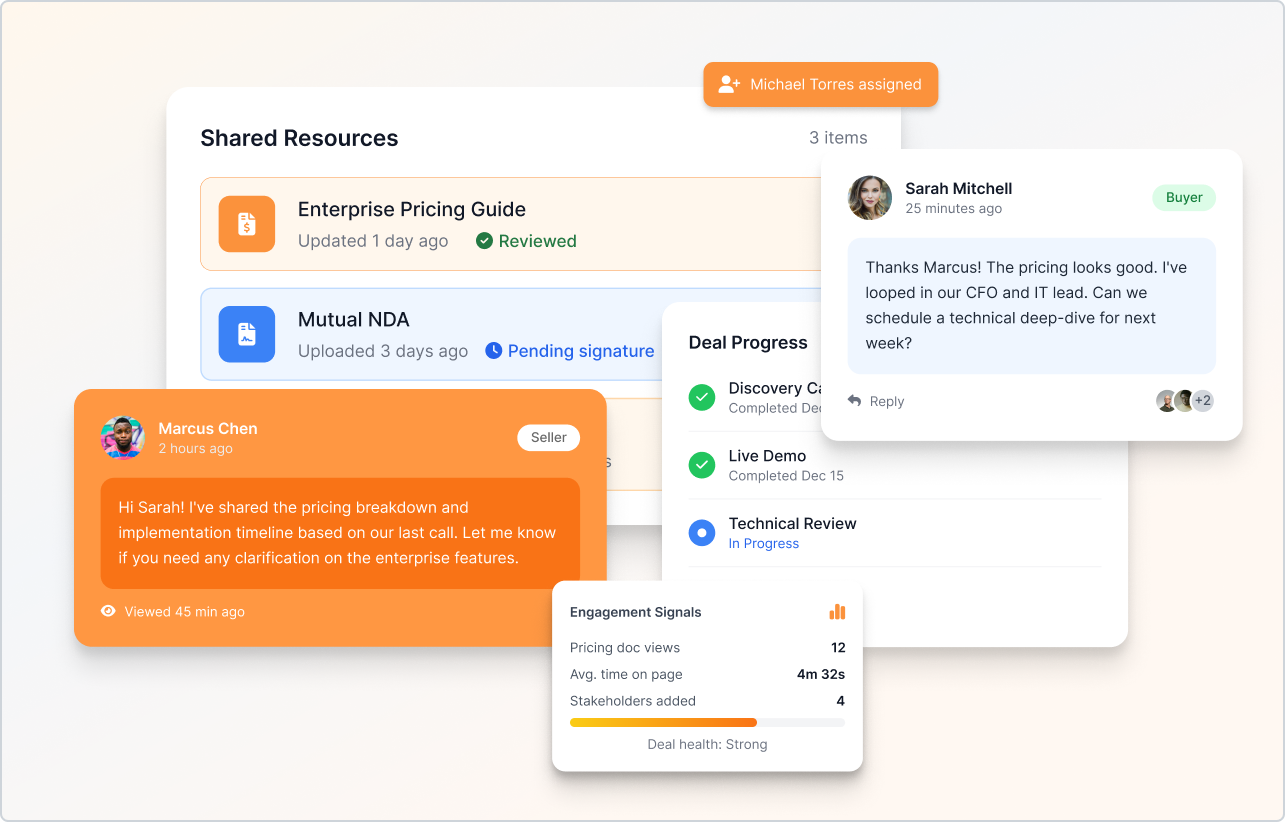
Shared deal environments, structured next step planning, and curated information flows can serve both sellers and buyers when designed intentionally. Sellers gain visibility and structure. Buyers gain clarity and continuity.
The overlap works best when enablement is designed as a shared experience rather than a one sided tool. If the experience favors sellers too heavily, buyers feel managed. If it favors buyers without supporting sellers, execution becomes fragmented.
The overlap reflects a simple truth. Selling and buying are interconnected once a deal is in motion.
One reason sales enablement vs buyer enablement becomes confusing is that sellers think in stages while buyers think in tasks.
Buyers must identify the problem, define requirements, evaluate options, validate risk, and reach agreement. These tasks often overlap and repeat. Progress is not linear.
Sales enablement supports how sellers contribute to these tasks through messaging, guidance, and structure. Buyer enablement supports whether buyers can complete them without internal friction.
If deals consistently stall at validation or consensus, the issue is rarely seller readiness. It is usually that buyers lack the tools or clarity to move forward internally.
Looking at buyer tasks rather than seller stages makes the distinction between the two enablement models much clearer.
A common mistake is treating enablement as a content problem. Teams produce more materials without defining whether those materials are meant to change seller behavior or buyer behavior.
Another mistake is assuming that strong sales enablement automatically creates buyer enablement. Well prepared sellers cannot compensate for unclear buyer processes.
Some organizations overcorrect by separating sales enablement and buyer enablement into isolated initiatives. This often creates disjointed workflows where sellers and buyers experience the process differently.
Most failures stem from unclear intent rather than lack of effort.
Teams that handle sales enablement vs buyer enablement well treat enablement as a system rather than a collection of assets.
Every resource has a defined role. Some exist to guide sellers. Some exist to support buyers. Some are intentionally designed to serve both.
Timing is deliberate. Resources are introduced when they solve a problem the buyer is actively facing. Feedback from live deals informs continuous refinement.
Enablement becomes a control system that reduces friction on both sides of the deal rather than an accumulation of tools.
Growth slows when either sellers or buyers become the bottleneck. Sales enablement prevents execution breakdowns. Buyer enablement prevents decision breakdowns.
Understanding sales enablement vs buyer enablement allows teams to diagnose friction accurately and intervene with precision. It replaces guesswork with structure.
When both disciplines work together, deals move with less resistance. Buyers feel supported rather than pressured. Sellers operate with confidence rather than improvisation.
That alignment is what turns enablement into a long term growth driver rather than a supporting function.
Understanding the difference between sales enablement and buyer enablement is useful only when it can be applied inside real deals. The challenge for many teams is not choosing one over the other, but creating a shared environment where seller execution and buyer decision making stay aligned throughout the process.
Buyerstage is built to support both sides of that equation. It provides a structured space where sales teams can guide conversations with clarity while buyers have a single place to review information, involve stakeholders, and move decisions forward without losing context.
For teams looking to connect sales enablement and buyer enablement within active opportunities, Buyerstage offers a practical way to evaluate how alignment changes when both are designed into the same workflow.
The comparison between sales enablement versus buyer enablement usually appears when revenue teams sense that effort and outcomes are no longer aligned. Sellers are active, pipelines look full, and conversations are happening, yet deals stall or stretch far longer than expected. In these situations, the issue is rarely motivation or messaging. It is usually a mismatch between how sellers are enabled and how buyers are supported through decision making.
Sales enablement and buyer enablement are closely related, but they exist to solve different problems. Treating them as the same concept often leads teams to over optimize internal execution while leaving buyers to navigate complex decisions on their own. Understanding the difference is essential for diagnosing friction and building systems that support sustainable growth.
Sales enablement refers to the systems, processes, and shared knowledge that help sales teams operate consistently and effectively. Its primary purpose is to ensure sellers know how to engage buyers, communicate value, and progress opportunities in a repeatable way.
Sales enablement is internal by design. It focuses on readiness. This includes onboarding new sellers, standardizing messaging, clarifying qualification criteria, and reinforcing how deals should be run from first conversation through close. When sales enablement is strong, sellers across the organization approach similar situations with similar structure, even if their styles differ.
Chronologically, sales enablement supports sellers from the earliest stages of the revenue process. It influences how discovery is conducted, how needs are framed, and how opportunities are assessed. Over time, it reduces dependency on individual intuition and replaces it with shared patterns based on what has worked before.
Buyer enablement focuses on a different part of the equation. It exists to support buyers as they move through the work required to make a decision.
Once a sales conversation begins, buyers face challenges that are often invisible to sellers. They must align internally on the problem, agree on evaluation criteria, compare alternatives, manage risk, and reach consensus among stakeholders with different priorities. These steps are not automatic, and they do not follow a clean sequence.
Buyer enablement provides structure to this process. It helps buyers organize information, understand what decisions remain, and bring others into the conversation without losing context. Instead of pushing buyers forward, buyer enablement removes obstacles that slow them down.
Buyer enablement becomes increasingly important as deals move into evaluation and approval phases. When interest is high but progress slows, buyer enablement is often the missing layer.
The simplest way to understand sales enablement versus buyer enablement is to look at who each discipline is designed to help first.
Sales enablement is designed to help sellers execute effectively. Buyer enablement is designed to help buyers decide confidently.
Sales enablement answers the question of whether the seller knows what to do next and how to do it well. Buyer enablement answers whether the buyer knows how to move forward internally and complete the decision process.
This distinction matters because the same asset can serve very different purposes depending on intent. A presentation can help a seller explain value, or it can help a buying group align around priorities. When teams do not clarify intent, enablement efforts become unfocused.
In practice, sales enablement shows up as clarity and consistency. Sellers know which conversations matter at which stage. They understand how to frame problems in a way that resonates with buyers. They have access to information that supports the conversation they are having right now, not a generic library of materials.
Sales enablement also creates feedback loops. Patterns from successful and unsuccessful deals inform training, messaging, and process improvements. Over time, this creates a learning system where execution improves continuously rather than through periodic overhauls.
When sales enablement is weak, teams rely on individual experience. Outcomes vary widely. Forecasts become unreliable. Deals fail for preventable reasons such as misaligned expectations or missed steps.
Buyer enablement works by reducing cognitive and organizational friction. It recognizes that buyers are often managing decisions alongside full time responsibilities and competing priorities.
In practice, buyer enablement helps buyers answer practical questions. Who needs to be involved. What information matters most. What steps remain before a decision can be made. By making this work explicit, buyer enablement reduces delays caused by uncertainty.
Buyer enablement does not replace sales conversations. It complements them by extending value beyond meetings. It supports the work buyers do between interactions, where many deals quietly lose momentum.
When buyer enablement is absent, buyers may disengage not because they are uninterested, but because the decision feels too difficult to complete.
Sales enablement and buyer enablement differ in focus, timing, and measurement.
Sales enablement focuses on seller readiness and execution quality. It is typically measured through indicators such as consistency across deals, ramp time, and adherence to process.
Buyer enablement focuses on buyer progress and decision confidence. It is reflected in shorter evaluation cycles, fewer stalled opportunities, and smoother internal approvals.
Sales enablement is usually owned internally. Buyer enablement is experienced externally. Both influence revenue, but they do so through different mechanisms.
Confusing the two often leads to misdirected investment. Teams may add more sales training when the real issue is buyer indecision. Or they may build buyer facing resources without ensuring sellers know how to use them effectively.
Despite their differences, sales enablement and buyer enablement overlap during active deals. This overlap is where modern revenue execution happens.
Shared deal environments, structured next step planning, and curated information flows can serve both sellers and buyers when designed intentionally. Sellers gain visibility and structure. Buyers gain clarity and continuity.
The overlap works best when enablement is designed as a shared experience rather than a one sided tool. If the experience favors sellers too heavily, buyers feel managed. If it favors buyers without supporting sellers, execution becomes fragmented.
The overlap reflects a simple truth. Selling and buying are interconnected once a deal is in motion.
One reason sales enablement vs buyer enablement becomes confusing is that sellers think in stages while buyers think in tasks.
Buyers must identify the problem, define requirements, evaluate options, validate risk, and reach agreement. These tasks often overlap and repeat. Progress is not linear.
Sales enablement supports how sellers contribute to these tasks through messaging, guidance, and structure. Buyer enablement supports whether buyers can complete them without internal friction.
If deals consistently stall at validation or consensus, the issue is rarely seller readiness. It is usually that buyers lack the tools or clarity to move forward internally.
Looking at buyer tasks rather than seller stages makes the distinction between the two enablement models much clearer.
A common mistake is treating enablement as a content problem. Teams produce more materials without defining whether those materials are meant to change seller behavior or buyer behavior.
Another mistake is assuming that strong sales enablement automatically creates buyer enablement. Well prepared sellers cannot compensate for unclear buyer processes.
Some organizations overcorrect by separating sales enablement and buyer enablement into isolated initiatives. This often creates disjointed workflows where sellers and buyers experience the process differently.
Most failures stem from unclear intent rather than lack of effort.
Teams that handle sales enablement vs buyer enablement well treat enablement as a system rather than a collection of assets.
Every resource has a defined role. Some exist to guide sellers. Some exist to support buyers. Some are intentionally designed to serve both.
Timing is deliberate. Resources are introduced when they solve a problem the buyer is actively facing. Feedback from live deals informs continuous refinement.
Enablement becomes a control system that reduces friction on both sides of the deal rather than an accumulation of tools.
Growth slows when either sellers or buyers become the bottleneck. Sales enablement prevents execution breakdowns. Buyer enablement prevents decision breakdowns.
Understanding sales enablement vs buyer enablement allows teams to diagnose friction accurately and intervene with precision. It replaces guesswork with structure.
When both disciplines work together, deals move with less resistance. Buyers feel supported rather than pressured. Sellers operate with confidence rather than improvisation.
That alignment is what turns enablement into a long term growth driver rather than a supporting function.
Understanding the difference between sales enablement and buyer enablement is useful only when it can be applied inside real deals. The challenge for many teams is not choosing one over the other, but creating a shared environment where seller execution and buyer decision making stay aligned throughout the process.
Buyerstage is built to support both sides of that equation. It provides a structured space where sales teams can guide conversations with clarity while buyers have a single place to review information, involve stakeholders, and move decisions forward without losing context.
For teams looking to connect sales enablement and buyer enablement within active opportunities, Buyerstage offers a practical way to evaluate how alignment changes when both are designed into the same workflow.
